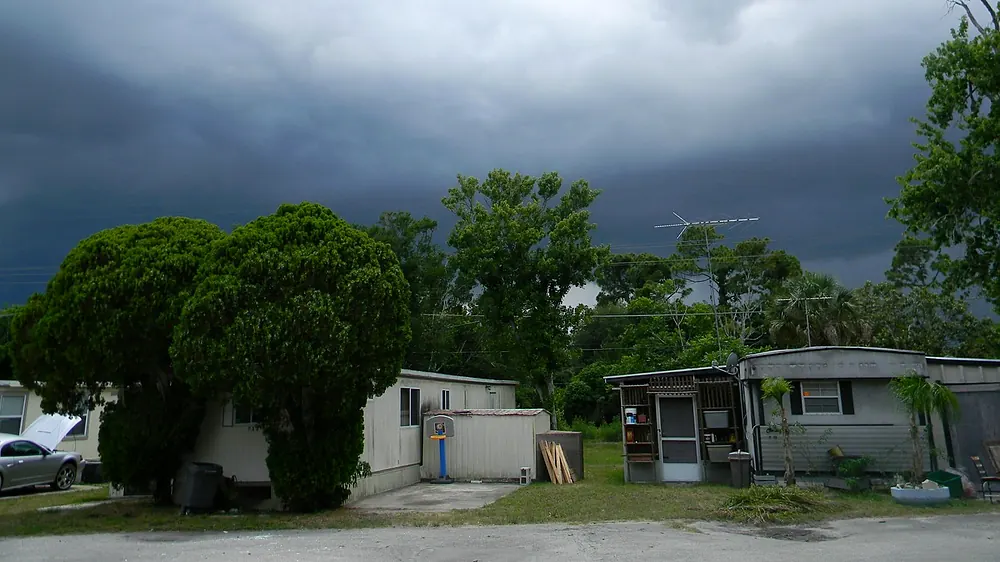
Why tie-downs matter here
- Polk County is in HUD Wind Zone II, the 100 mph zone. See 24 CFR 3280.305.
- After Hurricane Charley in 2004, FEMA found widespread damage to homes built before the 1976 HUD rules, and only some improvement in homes from 1976 to 1994. Newer homes typically had minimal structural damage and stayed on their foundations when they were installed to state requirements. See FEMA P-85.
- Hurricane Milton's gusts reached 87 mph at Winter Haven's airport in 2024, before the instrument stopped reporting. See NWS Tampa Bay.
- About 77% of occupied mobile homes in Polk were built before 2000, so many tie-down systems here may be decades old.
What an inspection covers
- Straps: tight, undamaged and free of rust. FLHSMV says to replace straps or ground anchors that show signs of corrosion or damage. See FLHSMV's safety page.
- Anchors: rust at the head, and any sign the anchor has moved.
- Strap angle: HUD's tables put diagonal straps between 30 and 60 degrees from the ground. See 24 CFR 3285.402.
- Spacing: count the anchors and measure the gaps against the rule below.
- Over-the-roof straps on older homes: Polk's used-home standard says they must be free of damage.
- The home itself: it should sit centered on its piers.
Florida's tie-down rules
- Diagonal ties, in all wind zones: no more than 5 feet 4 inches apart on center, with anchors within 2 feet of each end.
- Longitudinal ties, which resist wind on the ends of the home: at least four anchors and straps at the end of each section, or 16 on a double-wide.
- Centerline ties: required on all new and used multi-section homes.
- Frame ties: a factory strap on a state-approved I-beam clamp.
- These come from Rule 15C-1.0104. Older homes may have been set under earlier rules, so ask what your home needs. FLHSMV says anchoring products must be certified by the state.
Sand and water
FEMA says screw anchors hold less in submerged sand than in dry sand, and that the loss is greater for shallow anchors. That matters on low lots, near lakes and anywhere water stands after a storm. Polk's set-up paperwork includes a soil test and an anchoring affidavit signed by the installer. If your yard floods, have the anchors looked at once it dries out.
When to have them checked
- Before hurricane season, which runs June 1 to November 30.
- After any major storm or flood. FEMA says anchors should be inspected periodically, especially after hazard events.
- After leveling, or any work that loosened the straps.
- When you buy a used home.
Who can do it
FLHSMV tells owners to have the tie-down system checked by a licensed mobile home installer. Its list of licensed installers is updated monthly. In a park, the owner can't make you buy tie-down equipment from the park. It can set the style or quality if that's in your prospectus, and you buy from the vendor you choose. See Fla. Stat. 723.043.
Florida's free tie-down program
The state funds a Mobile Home Tie-Down Program through Gulf Coast State College. It's for homes installed in 1999 or earlier, costs the owner nothing, and covers taking off and putting back skirting. Parks and managed communities apply as a group, and owners on private land can apply on their own. The college warns it can take several years to reach a park. Its page doesn't list counties, so ask whether Polk is being served: tiedownprogram@gulfcoast.edu. See the program page.
What tie-down work costs
FEMA's 2009 estimate says tightening straps typically costs a few hundred dollars or less, and replacing anchors or resetting a home at least $1,000. Prices have gone up since then. Two older Lakeland permits give a local check: new anchors on an existing home were declared at $2,700 in 2015, and blocking plus tie-downs at $3,285 in 2016. Get a written quote that counts the anchors and straps being added or replaced.
Questions to ask before you sign
- Are you licensed by FLHSMV, and what's your number?
- How many anchors and straps will you add or replace, and where?
- Are the anchors and clamps state-approved?
- Will you check level first?
- Who takes off and puts back the skirting?
- Does this job need a permit?